
In the highly specialized realm of musculoskeletal oncology, Ewing Sarcoma represents one of the most aggressive yet medically fascinating malignancies. As a primary malignant small round blue cell tumor, it demands a sophisticated, multi-disciplinary approach.
At Ezyhealthcare, we serve as your global clinical bridge, connecting patients with the world’s leading orthopedic oncologists and pediatric specialists. This extensive guide provides an in-depth exploration of the disease, ensuring you are equipped with the latest clinical knowledge.
1. Pathophysiology and Genetic Drivers
Ewing Sarcoma is the second most common bone cancer in children and adolescents. While it predominantly affects the skeletal system, it is fundamentally a disease of genetic translocation.
The Molecular Signature
Unlike many cancers that result from a lifetime of environmental exposure, Ewing Sarcoma is driven by a singular, catastrophic genetic event. In approximately 85% of cases, a translocation occurs between chromosomes 11 and 22, denoted as t(11;22)(q24;q12).
- The Fusion Protein: This translocation fuses the EWS gene with the FLI1 gene.
- Transcriptional Hijacking: The resulting EWS-FLI1 fusion protein acts as an aberrant transcription factor. It turns “on” genes that drive cell proliferation and turns “off” genes that regulate cell death (apoptosis).
- The Cell of Origin: Current research suggests these tumors arise from mesenchymal stem cells or primitive neuroectodermal cells.
2. Clinical Presentation and Warning Signs
The diagnosis of Ewing Sarcoma is frequently delayed because its early symptoms mimic common orthopedic conditions like sports injuries, osteomyelitis (bone infection), or “growing pains.”
Localized Manifestations
- Bone Pain: This is the hallmark symptom. It is often deep, persistent, and progressively worsens. Crucially, the pain often intensifies at night or during rest.
- Palpable Mass: A soft tissue mass may develop over the bone. In cases of Askin tumors (Ewing sarcoma of the chest wall), this can lead to respiratory distress or pleural effusion.
- Neurological Deficits: If the tumor originates in the vertebrae or pelvis, it may compress nerves, leading to weakness, numbness, or bowel/bladder dysfunction.
Systemic Indicators
When the disease is advanced or metastatic, constitutional symptoms appear:
- Intermittent low-grade fevers.
- Unexplained weight loss and cachexia.
- Elevated Erythrocyte Sedimentation Rate (ESR) and Lactate Dehydrogenase (LDH)—the latter often serving as a marker for high tumor burden.
3. The Gold Standard of Diagnosis
A definitive diagnosis requires a combination of high-resolution imaging and molecular pathology.
- Conventional Radiography: X-rays often show a “moth-eaten” appearance of the bone or the classic “onion-skin” periosteal reaction, where the bone forms concentric layers of new tissue in response to the tumor.
- MRI (Magnetic Resonance Imaging): Essential for determining the “soft tissue envelope.” It helps surgeons see how much of the cancer has invaded nearby muscles and nerves.
- PET/CT Staging: Used to identify distant metastases. The most common sites of spread are the lungs (70-80% of metastatic cases), followed by other bones and bone marrow.
- Biopsy and Histology: A core needle biopsy is analyzed under a microscope to find “small round blue cells.” Confirmation is achieved via FISH (Fluorescence In Situ Hybridization) or RT-PCR to detect the EWS-FLI1 fusion.
4. Multi-Modal Treatment Strategies
The modern management of Ewing Sarcoma is divided into systemic treatment and local control.
Systemic Therapy: The Frontline
Because Ewing Sarcoma is highly chemosensitive, treatment begins with Induction Chemotherapy. In the US and many international centers, the VDC/IE regimen (Vincristine, Doxorubicin, and Cyclophosphamide alternating with Ifosfamide and Etoposide) is the standard. This shrinks the primary tumor and addresses microscopic disease throughout the body.
Local Control: Preserving Form and Function
Once the tumor has responded to chemotherapy (usually after 9-12 weeks), local control is initiated:
- En Bloc Surgical Resection: The preferred method if the tumor can be removed with wide margins.
- Limb-Salvage Reconstruction: Using endoprosthetics (metal implants), allografts (donor bone), or vascularized fibular grafts to reconstruct the limb and avoid amputation.
- Radiotherapy: Utilized for tumors in surgically inaccessible areas (like the skull base or parts of the pelvis) or as an adjuvant if surgical margins are thin.
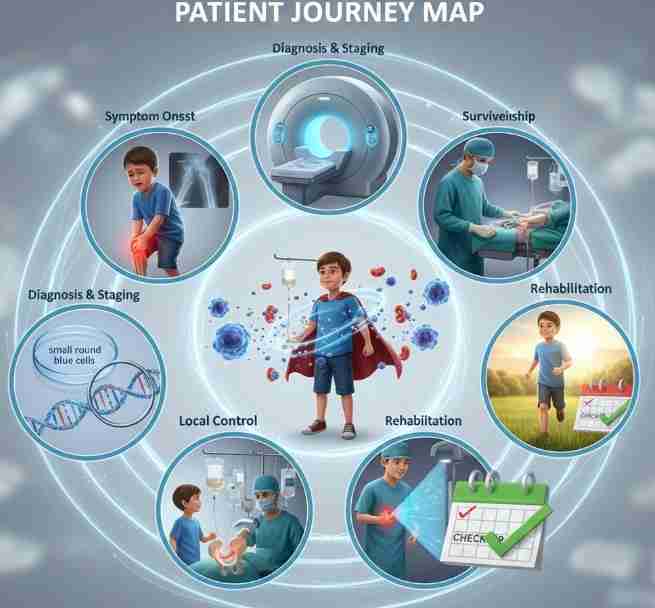
5. The Ewing Sarcoma Patient Journey Map
At Ezyhealthcare, we coordinate every phase of this complex timeline to ensure seamless care.
Phase I: Symptom Onset & Initial Screening (Weeks 1–3)
- Trigger: Persistent focal bone pain or a lump.
- Action: GP visit, initial X-ray, and referral to a specialist.
Phase II: Definitive Staging & Biopsy (Weeks 4–6)
- Tests: MRI, PET/CT, and Bone Marrow Aspiration.
- Confirmation: Biopsy and genetic molecular profiling.
- Decision: Multi-disciplinary Tumor Board meeting to map out the protocol.
Phase III: Neoadjuvant (Induction) Chemotherapy (Months 2–4)
- Goal: Cytoreduction (shrinking the tumor) and treating micrometastases.
- Process: Repeated hospital stays for IV chemotherapy infusions.
Phase IV: Local Control Intervention (Months 5–6)
- The Procedure: Radical surgery or targeted radiation therapy.
- Recovery: Initial post-operative healing and pain management.
Phase V: Adjuvant (Consolidation) Chemotherapy (Months 7–12+)
- Goal: Total eradication of any remaining malignant cells.
- Rehabilitation: Physical therapy starts to regain limb function.
Phase VI: Long-Term Surveillance (Years 1–10)
- Monitoring: Frequent imaging (CT/MRI) and blood work to monitor for recurrence or late effects of treatment (such as cardiotoxicity).
Contact Ezyhealthcare for Global Expert Coordination
If you are navigating a sarcoma diagnosis, you do not have to do it alone. We provide access to top-tier oncology centers in Australia, Europe, and Asia.
- SMS: 0477765003
- WhatsApp: +61 0427 877 660
- Email: info@ezyhealthcare.net
- Address: PO Box 1997 North Sydney NSW 2059
Medical Disclaimer
The information provided in this article is for educational and informational purposes only and is not intended as medical advice. Ewing Sarcoma is a serious condition that requires professional diagnosis and treatment by a qualified healthcare provider. Always seek the advice of your physician or other qualified health provider with any questions you may have regarding a medical condition. Never disregard professional medical advice or delay in seeking it because of something you have read on this website.
